
What’s the first thing you think of when someone mentions a NYC plane crash? The vast majority will immediately think of the September 11th attacks. Some might remember the November 2001 American Airlines Flight 587 accident, AKA the deadliest NYC plane crash. Some might even recall the mid-air collision between United Airlines Flight 826 and a Trans World Airlines Flight 266 in mid-December 1960, which killed 134 people. Today, however, we won’t be talking about any of them. Instead, the often-forgotten 1945 Empire State Building crash will be the centre of our focus.
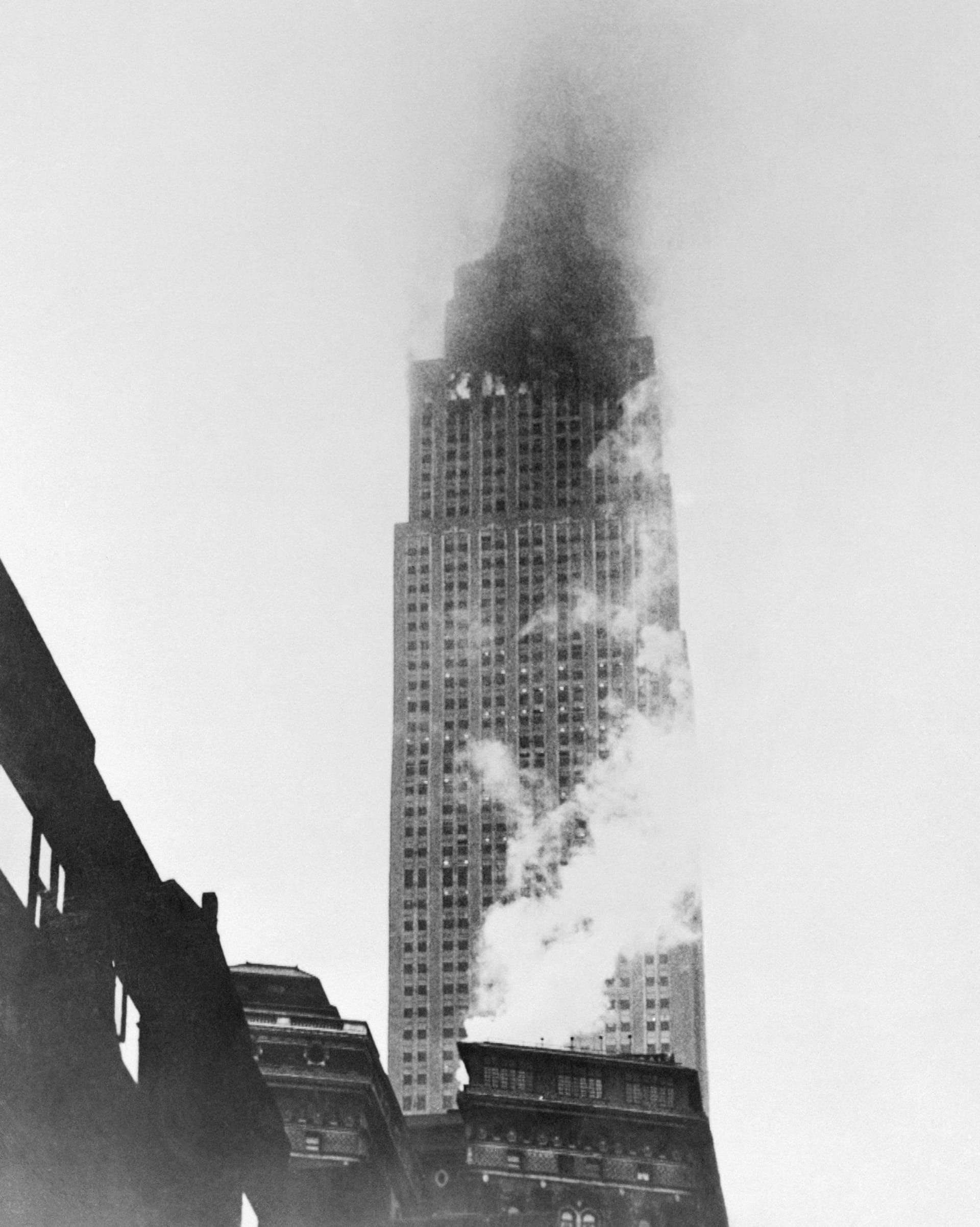
July 28, 1945 was an exceptionally foggy day for NYC standards. Although WWII had been over for almost three months in Europe, Americans were still actively fighting on the Pacific front, with the Battle of Okinawa having been won only a little over a month prior. Despite the fact that the end of the war was already on the horizon, Americans were still unsure how the end of the war would actually play out, even fearful of a potential attack on U.S. soil. In fact, the Fu-Go balloon bomb, an incendiary balloon weapon developed by the Japanese and used against the United States between 1944 and mid 1945, had killed six civilians in Bly, OR, in early May 1945.[1] So, it’s safe to say many were reasonably paranoid.
For Lt. Col. William Franklin Smith Jr., July 28, 1945, started off as a regular working day. Smith Jr. was piloting a B-25 Mitchell bomber as part of a usual personnel transport mission from Bedford Army Air Field in Bedford, MA, to Newark, NJ. While the pilot was in contact with LaGuardia Airport due to fog concerns, air traffic control was in disagreement with army aviation authorities in regard to landing immediately at Newark Metropolitan Airport (Newark Liberty International Airpot today).[2] Ultimately, Smith Jr. was cleared to continue flying towards Newark.
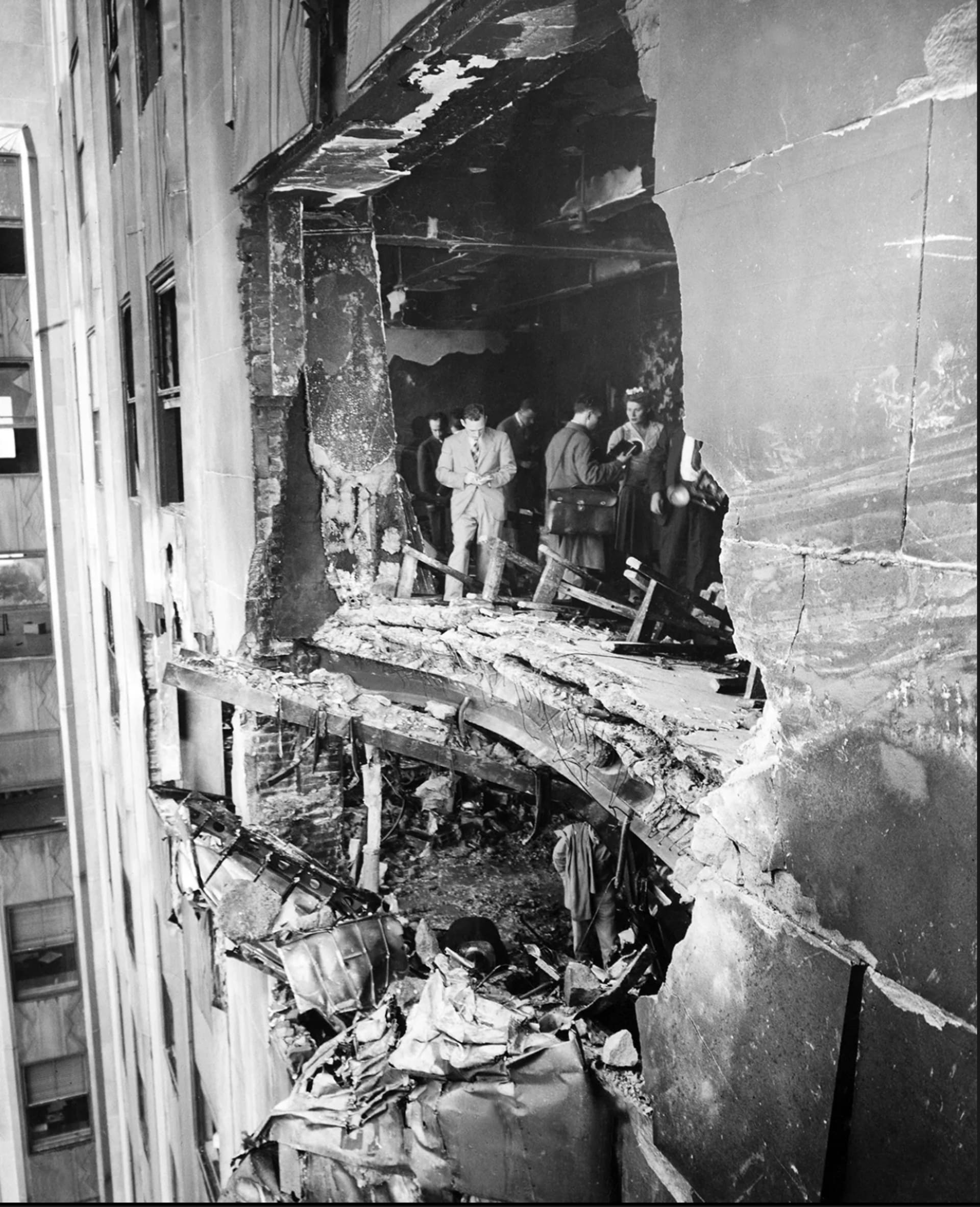
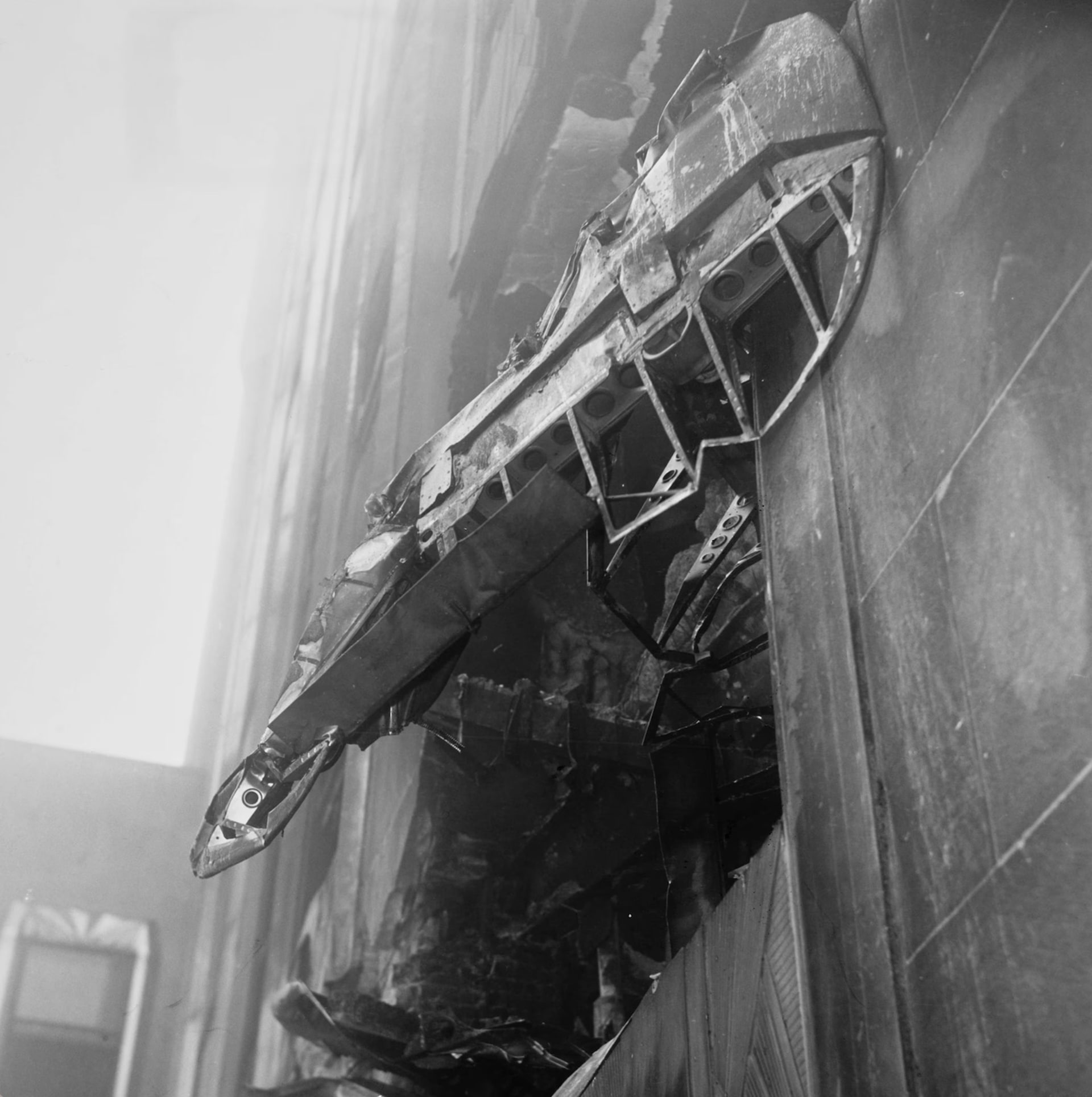
The fog was especially debilitating above NYC, and Smith Jr. had become disoriented because of it, resulting in him turning right instead of left and flying very close to the Chrysler building.[3] The plane impacted the north face of the Empire State Building at 9:40 a.m., hitting between floors seventy-eight and eighty, and leaving a gaping hole where the offices of War Relief Services and National Catholic Welfare Council used to be.[4] Unsurprisingly, many that witnessed the accident thought the Kamikaze crossed the Pacific and decided to strike the U.S. when they expected it the least.
The three crewmen aboard the aircraft all perished, alongside eleven civilians in the building. The impact caused one of the engines to fly out of the building’s south side, landing on a roof of a nearby building and destroying a penthouse art studio. The other engine fell down an elevator shaft, severing its cables and resulting in elevator operator Betty Lou Oliver surviving an over three hundred meters (one thousand feet) fall from the seventy-fifth floor all the way to the basement. This is still the world record for the longest survived elevator fall.[5]

To this day, the Empire State Building crash, and consequent fire, remains the highest structural fire that the FDNY successfully brought under control. In fact, the building was opened for business less than forty-eight hours after the accident. The event set in motion the enactment of the long-awaited Federal Tort Claims Act, signed into law by President Truman in August 1946, which allowed private citizens to sue the U.S. government for most torts.[6]
The Empire State Building crash ties interestingly to the Twin Towers of the WTC. When Minoru Yamasaki, the primary architect of the Twin Towers, began designing the two towers in the 1960s, he used the Empire State Building as a point of reference for having withstood an impact of an aircraft and decided to make his towers as resistant as possible to a potential airplane impact. However, at the time, a Boeing 707 was the largest aircraft in the world, and Yamasaki imagined that if a plane were to hit one of the towers, it would be at a low speed and by accident. He couldn’t imagine anyone deliberately crashing an airplane into one of his towers.[7]

For many that remember the events of September 11th, there’s yet another connection to the 1945 Empire State Building crash. For seventeen minutes between the impact of American Airlines Flight 11 into the north face of the North Tower and the impact of United Airlines Flight 175 into the south face of the South Tower, most people thought it was a terrible accident, despite the clear-blue skies and no other unfavourable weather conditions. At 09:03 a.m., however, there was no doubt as to what was happening.
The story of the 1945 Empire State Building crash was seen as a cautionary tale, one that remained in the collective memory of all those who were around when it happened. Until 2001, it’s all that came to mind when someone mentioned New York and a plane crash in the same sentence. The events of 9/11 rendered this event almost obsolete in NYC history, turning it into a historical footnote that’s more often forgotten than remembered.
It’s also undeniably fascinating and worth remembering. A disaster that took place just before the end of WWII when most Americans had justified reasons for fearing a Japanese retaliation on U.S. soil, the NYC forgotten plane crash remains a captivating piece of the city’s history that shaped the city’s future. Although the Twin Towers, unfortunately, no longer stand, their design was directly influenced by a, no doubt, traumatic event for many New Yorkers. Hadn't it been for al-Qaeda, I bet the towers would still be up, and in some way, that’s also a part of the legacy of the city’s forgotten plane crash.


